P&K: MAKE EVERY POUND COUNT
Key points:
- Soil test results and yield maps provide data farmers need for fertility efficiency.
- Pulling back applications of P&K for a year or two is unlikely to exhaust reserves.
- Nutrient balance and soil pH also impact nutrient availability to the corn plant.
Farmers are scrutinizing every input carefully as they strive for profitability in 2026. That includes striking the balance between supplying crops with the phosphorus (P), potassium (K) and other nutrients they need to perform and keeping production costs in check.
Start with soil test and yield maps
Step 1 is gathering soil test results and yield maps. These provide farmers the data they need to determine how to be as efficient and strategic as possible with their fertility applications. “A good soil test shows a farmer how and where to spend those fertility dollars most wisely,” says AgriGold Agronomist Jeff Morey.
Yield maps can help farmers accurately account for nutrient removal rates, Morey says, noting it’s important that fertility plans account for today’s higher yields. He encourages farmers to turn to their respective extension offices or work with their trusted advisors to better understand critical levels of P and K.
Using “banked” P&K
“Think about your soil as a bank,” Morey advises. “If you’ve been banking nutrients for years and P and K levels are high or very high, you can pull back on application rates.”
In today’s budget environment, some farmers may opt to apply a maintenance or removal-only rate, while others may switch to a banded application with reduced rates within that band, Morey says. Pulling back for a year or two likely won’t exhaust reserves of P and K. “Yes, you’ll draw them down, but it’s not a quick depletion,” he says.
In fact, he points to research from the University of Minnesota indicating many farmers put on enough P for two crops. “Most farmers will typically apply enough fertilizer, particularly P and K, in the fall to provide enough fertility to grow the next two years of crops, typically corn and soybeans in my Iowa territory,” Morey elaborates. Of course, there are always exceptions to that rule and when margins tighten some farmers may only apply enough fertilizer for a single crop.
Nutrient balance matters, too
It’s important to maintain adequate levels of both phosphorus, which supports emergence and early plant growth, and potassium, which affects standability. But the balance between them matters just as much. “If phosphorus is high and potassium is low, the crop can’t use either nutrient efficiently so yields can suffer,” Morey explains.
Generally, balance isn’t an issue with commercial fertilizer applications, Morey says. “But it is a common issue for those using phosphorus-rich manure.”
Farmers with excess phosphorus in the soil should focus on raising their potassium level, recognizing that it can take several years to rectify imbalances.
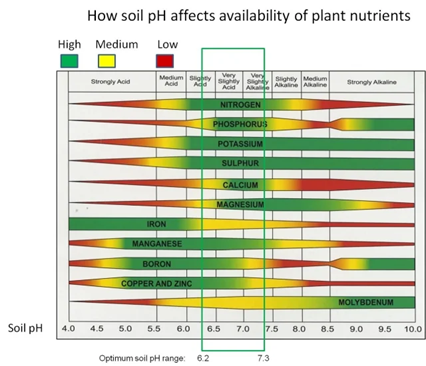
Soil pH impacts nutrient availability
Soil pH also plays a role in how well corn can take up essential plant nutrients. “Ideally, I like to see soil pH between 6.5 and 7.0,” Morey says. “Correcting soil pH is one of the most cost-effective ways to improve nutrient availability in crop production.”
“If soil pH is low, applying lime can help — especially when soil tests show high nutrient levels,” according to Morey. If soil pH is high, options include improving drainage or applying sulfur, Morey says, noting some farmers have increased yields with sulfur applications.
Leverage VRT to optimize nutrient application
Variable rate technology (VRT) can help farmers optimize nutrient placement. With grid soil samples, they can build an application prescription that delivers the right amount of nutrient in the right place.
A farmer might have areas of a field producing big yields thanks to fertile soil, ideal pH and effective drainage. Knowing that, the grower can monitor soil test levels closely, recognizing that big yields may have drawn P and K down to levels necessitating some extra nutrients to return to optimal levels.
On the other hand, there may be areas of a field that yielded well, but soil tests still show high levels of P and K. In that scenario, the farmer may be able to pull back on application rates using VRT for those acres.
All that to say, taking a blanket approach to fertility or soil sampling can limit productivity in some areas while wasting inputs in others. Knowing what nutrients are present and available across a corn field can help farmers be efficient and strategic with their fertility for growing seasons to come, a key component to overall profitability.
For support making the most of every acre — whether that’s choosing seed or interpreting soil test results — reach out to your local AgriGold agronomist.